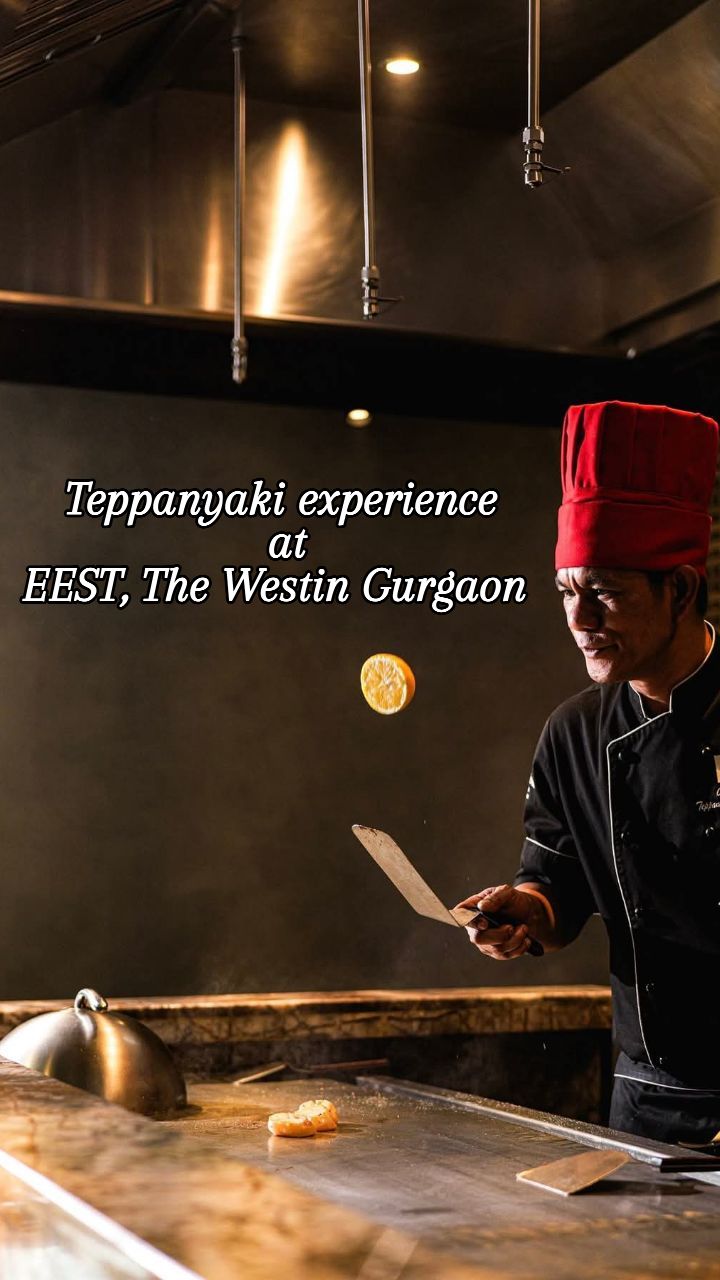
The Theatre of the Teppan - When dinner becomes a performance, and the chef is the lead actor. There is a peculiar kind of loneliness to eating in most fine dining restaurants in this country. You sit at your table, beautifully appointed as it may be, and somewhere behind a wall, in a kitchen you will never see, things happen to your food. A sauce is reduced. A protein is seared. A garnish is placed with tweezers. And then a plate arrives at your table, immaculate and composed, as if it had always existed in precisely that form — with no history, no drama, no human story attached to it. I have always found this slightly unsatisfying. Not the food, necessarily. The experience. Which is why I have such a deep fondness for Teppanyaki. It is, among all the Japanese culinary traditions to have found a home in India, the one that most completely refuses to hide its workings. There is no curtain here. No mystery. Instead, there is fire, and steel, and a chef who performs directly in front of you — a craftsman who cannot fake it, because you are watching every single move. I went, recently, to try the Teppanyaki experience at EEST — the pan-Asian restaurant at The Westin Gurgaon — and I came away thinking that this is precisely the kind of dining experience that Gurgaon, for all its ambition and appetite, has been quietly missing. A Word About the Style of Cooking, First Let me explain Teppanyaki for those who have encountered the word but remain uncertain about what it actually involves. The teppan is a large, flat iron griddle — a cooking surface of considerable heft and heat-retention. The yaki simply means grilled or pan-fried. In practice, Teppanyaki refers to a style of cooking developed in Japan in the mid-twentieth century — and subsequently elevated by restaurants like Benihana in America into something approaching theatrical spectacle — in which a skilled chef prepares your meal on this flat-top griddle, in your presence, at close quarters. The important thing to understand is that Teppanyaki, for all its showmanship, is not mere entertainment. The technique is disciplined and demanding.
 89
89  113
113 This post was published on 24th April, 2026 by Rahul on his Instagram handle "@rahulprabhakar (Rahul Prabhakar)". Rahul has total 69.5K followers on Instagram and has a total of 2.5K post.This post has received 89 Likes which are lower than the average likes that Rahul gets. Rahul receives an average engagement rate of 0.32% per post on Instagram. This post has received 113 comments which are lower than the average comments that Rahul gets. Overall the engagement rate for this post was lower than the average for the profile.
Hidden 97  21-07-2026 123 160 20-07-2026 109 116 17-07-2026 102 142 16-07-2026 162 153 15-07-2026 192 139 07-07-2026 94 125 05-07-2026 117 108 04-07-2026 84 110 30-06-2026 106 126 29-06-2026 128 119 23-06-2026 106 109 22-06-2026 93 120 19-06-2026 104 106 18-06-2026 112 118 16-06-2026 106 138 11-06-2026 111 107 07-06-2026 108 134 14-05-2026 135 120 18-04-2026 121 127 17-04-2026 159 121 13-01-2026 89 112 11-01-2026 94 112 10-01-2026 76 104 09-01-2026 85 106 06-01-2026 84 111 04-01-2026 72 98 03-01-2026 82 106 30-12-2025 81 92 28-12-2025 124 73 22-12-2025 125 112 21-12-2025 121 133 20-12-2025 90 109 19-12-2025 100 132 18-12-2025 88 103 16-12-2025 89 111 15-12-2025 96 100 13-12-2025 97 104 12-12-2025 103 129 11-12-2025 87 104 10-12-2025 97 124 09-12-2025 154 102 08-12-2025 97 115 07-12-2025 129 112 05-12-2025 121 133 04-12-2025 88 113 02-12-2025 145 102 30-11-2025 88 131 27-11-2025 179 103 26-11-2025 106 141 25-11-2025 93 117 24-11-2025 128 138 23-11-2025 93 112 21-11-2025 109 120 20-11-2025 96 127 19-11-2025 84 126 15-11-2025 85 120 14-11-2025 Hidden 130 30-09-2025 176 58 15-02-2025