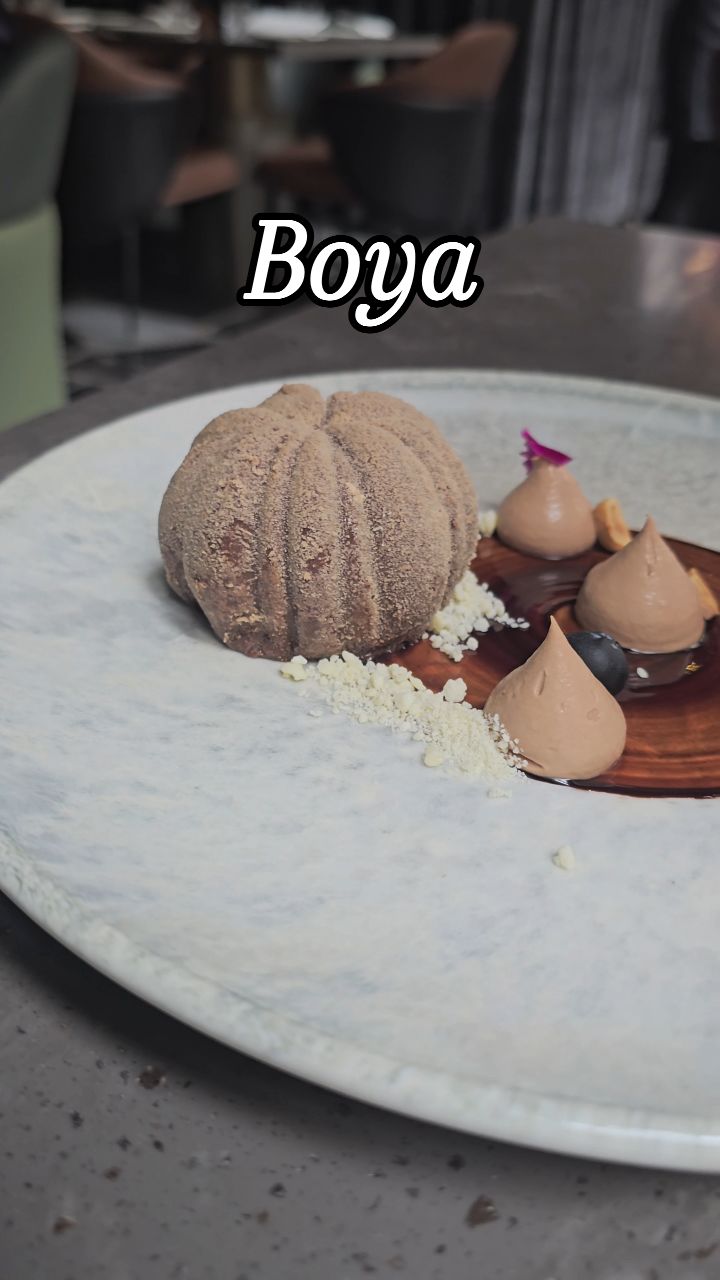
Boya, Malcha Marg: When Delhi Finally Gets Nikkei Right There is a moment, in any great meal, when you stop thinking about the food and simply surrender to it. It doesn't happen often enough in Delhi — a city that, for all its enthusiasm about dining out, can sometimes confuse ambition with execution. Which is why, when it does happen, it's worth writing about. Boya, tucked into the quietly elegant stretch of Malcha Marg in Chanakyapuri, gave me one of those moments. Several of them, in fact. Let me give you some context first. Nikkei cuisine — the gastronomic language that emerged from the Japanese immigrant communities of Peru — is one of the most sophisticated and genuinely exciting food cultures on the planet. It is not fusion in the pejorative sense that Indian restaurant menus have made us dread. It is something far more considered: a conversation between two culinary traditions that have, over more than a century, learned to genuinely understand each other. Tokyo has its Nikkei temples. Lima has elevated it to a national art form. That Delhi now has a serious practitioner of this cuisine is, frankly, overdue. The man responsible is Chef Augusto Cabrera, a sushi chef of evident seriousness and skill. The restaurant's name — Boya, meaning "sowing the seed" — turns out to be rather more than marketing poetry. There is, in the food that comes out of this kitchen, a genuine sense of something being planted for the first time. A new culinary vocabulary being established, carefully, dish by dish. I visited for the All Day menu, which in lesser restaurants can be a diplomatic way of saying "we couldn't be bothered to think too hard." At Boya, it is nothing of the sort. We began with the Tomato Basil Soup — roasted tomatoes with basil — which I approached with the mild scepticism one reserves for dishes that seem deceptively simple. I was, happily, wrong to be sceptical. The roasting had done its work properly: concentrating the sweetness, deepening the umami, producing something that tasted unmistakably of tomato at its most essential. The basil was there as a presence, not a garnish.
 99
99  113
113 This post was published on 27th March, 2026 by Rahul on his Instagram handle "@rahulprabhakar (Rahul Prabhakar)". Rahul has total 69.8K followers on Instagram and has a total of 2.4K post.This post has received 99 Likes which are lower than the average likes that Rahul gets. Rahul receives an average engagement rate of 0.33% per post on Instagram. This post has received 113 comments which are lower than the average comments that Rahul gets. Overall the engagement rate for this post was lower than the average for the profile.
Hidden 99  17-05-2026 90 98 16-05-2026 93 126 14-05-2026 93 110 13-05-2026 88 105 12-05-2026 99 139 08-05-2026 103 124 06-05-2026 83 117 05-05-2026 112 133 01-05-2026 91 129 30-04-2026 87 134 29-04-2026 95 121 27-04-2026 117 150 25-04-2026 85 111 24-04-2026 105 113 23-04-2026 87 101 20-04-2026 111 144 20-04-2026 131 120 18-04-2026 119 123 17-04-2026 91 118 16-04-2026 158 139 13-04-2026 134 137 10-04-2026 104 135 05-04-2026 84 76 05-04-2026 126 116 31-03-2026 105 139 29-03-2026 108 144 25-03-2026 111 158 23-03-2026 162 160 16-03-2026 114 134 13-03-2026 84 120 09-03-2026 83 105 07-03-2026 88 132 05-03-2026 121 130 26-02-2026 111 134 23-02-2026 93 129 20-02-2026 94 119 16-02-2026 107 161 14-02-2026 73 101 10-02-2026 78 110 09-02-2026 94 127 09-02-2026 118 137 08-02-2026 99 96 07-02-2026 89 128 06-02-2026 85 108 03-02-2026 93 108 01-02-2026 66 92 30-01-2026 76 99 29-01-2026 99 105 27-01-2026 87 104 26-01-2026 122 99 25-01-2026 101 109 24-01-2026 85 96 23-01-2026 75 106 22-01-2026 91 112 21-01-2026 102 111 20-01-2026 88 122 19-01-2026 111 101 18-01-2026 163 56 15-02-2025