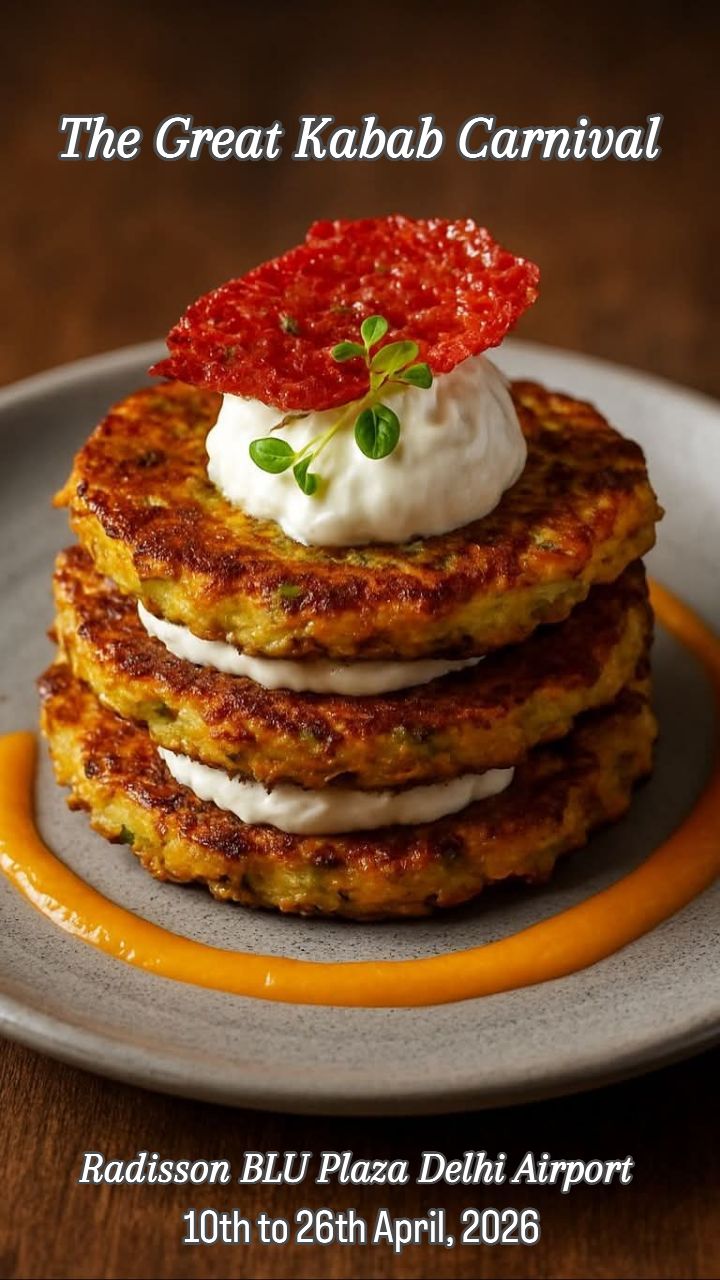
There is a particular kind of snobbery that afflicts those of us who write about food — and I say this as someone guilty of practising it myself. It is the assumption that serious kabab culture can only be encountered in the crumbling havelis of Lucknow, in the smoke-blackened kitchens of Old Delhi, or perhaps in Kolkata's dying mehmankhanas where the last of the nawabi traditions are preserved like pressed flowers between the pages of an old diary. The hotel restaurant, one tends to believe, is where these traditions go to be photographed for Instagram and drained of all their soul. It is a prejudice I was forced to examine — and promptly discard — when I recently sat down to dinner at Radisson BLU Plaza Delhi Airport for their ongoing Great Kabab Carnival. The premise is ambitious, perhaps even audacious. A single spread that attempts to stitch together the kabab cultures of Awadh, Bengal, Chettinad, Punjab, and Maharashtra — all under one roof, all on one evening. The cynic in me expected the culinary equivalent of a greatest-hits album: technically competent, emotionally hollow. What I found instead was something rather more interesting. On the Nature of the Kabab Before I tell you what I ate, permit me a small digression — one which I promise is relevant. The word "kabab" has been so thoroughly abused in modern restaurant parlance that it has lost almost all meaning. Every grilled piece of protein now gets the designation, from a sad paneer tikka served on a sizzler plate to the genuinely transcendent preparations that emerged from the royal kitchens of the Mughals and their successors. The galouti, the kakori, the seekh, the kalmi — these are not merely dishes. They are arguments about fire, fat, spice, and time. They are the result of centuries of refinement. Which is why what the kitchen here has done deserves to be taken seriously. The Starters — Where the Evening Finds Its Voice Let me begin, as all good kabab evenings must, with the galawat. Kabab-e-Gosht Galawat The kitchen's finest moment. Inspired by the royal kitchens of Awadh, this melt-in-the-mouth mutton galouti arrives as a small, trembling disc of minced meat.
 91
91  118
118 This post was published on 16th April, 2026 by Rahul on his Instagram handle "@rahulprabhakar (Rahul Prabhakar)". Rahul has total 69.8K followers on Instagram and has a total of 2.4K post.This post has received 91 Likes which are lower than the average likes that Rahul gets. Rahul receives an average engagement rate of 0.33% per post on Instagram. This post has received 118 comments which are lower than the average comments that Rahul gets. Overall the engagement rate for this post was lower than the average for the profile.
Hidden 99  17-05-2026 90 98 16-05-2026 93 126 14-05-2026 93 110 13-05-2026 88 105 12-05-2026 99 139 08-05-2026 103 124 06-05-2026 83 117 05-05-2026 112 133 01-05-2026 91 129 30-04-2026 87 134 29-04-2026 95 121 27-04-2026 117 150 25-04-2026 85 111 24-04-2026 105 113 23-04-2026 87 101 20-04-2026 111 144 20-04-2026 131 120 18-04-2026 119 123 17-04-2026 158 139 13-04-2026 134 137 10-04-2026 104 135 05-04-2026 84 76 05-04-2026 126 116 31-03-2026 105 139 29-03-2026 99 113 27-03-2026 108 144 25-03-2026 111 158 23-03-2026 162 160 16-03-2026 114 134 13-03-2026 84 120 09-03-2026 83 105 07-03-2026 88 132 05-03-2026 121 130 26-02-2026 111 134 23-02-2026 93 129 20-02-2026 94 119 16-02-2026 107 161 14-02-2026 73 101 10-02-2026 78 110 09-02-2026 94 127 09-02-2026 118 137 08-02-2026 99 96 07-02-2026 89 128 06-02-2026 85 108 03-02-2026 93 108 01-02-2026 66 92 30-01-2026 76 99 29-01-2026 99 105 27-01-2026 87 104 26-01-2026 122 99 25-01-2026 101 109 24-01-2026 85 96 23-01-2026 75 106 22-01-2026 91 112 21-01-2026 102 111 20-01-2026 88 122 19-01-2026 111 101 18-01-2026 163 56 15-02-2025