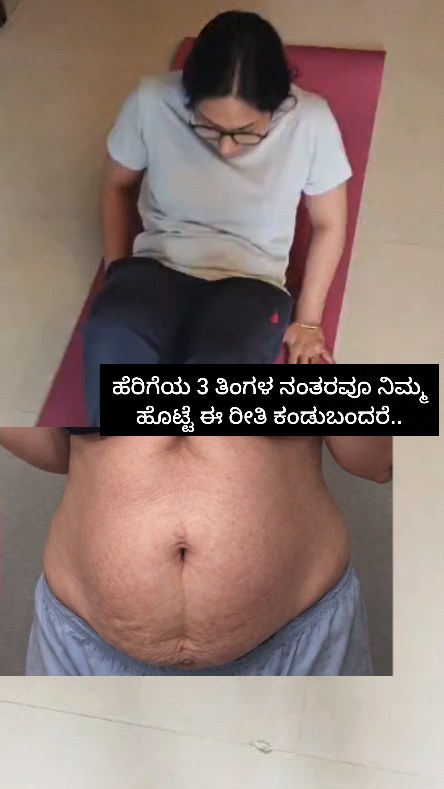
Diastasis recti is very common after delivery, and in most women it improves on its own. We worry only after a certain time frame. When is diastasis recti normal postpartum? 0–6 weeks postpartum → Completely normal Abdomen is still healing; uterus involution ongoing No active treatment except gentle care Expected natural recovery By 6–8 weeks → gap usually starts reducing By 12 weeks (3 months) → most mild–moderate diastasis improves significantly Up to 6 months postpartum → continued improvement possible with exercises When should we start worrying? After 8–12 weeks postpartum IF: Gap is >2–3 finger breadths Abdomen still bulges on coughing / sitting up Back pain or core weakness present Definitely evaluate after 3 months if: No improvement despite basic core activation Functional problems (pain, instability) After 6 months postpartum Persistent diastasis is unlikely to close on its own Needs targeted physiotherapy Surgical opinion only if severe & symptomatic What is considered significant diastasis? >2 cm (or >2 fingers) after 8–12 weeks Visible doming or coning What to do in the early period (important) ✔ Avoid crunches, sit-ups, planks early ✔ Avoid heavy lifting ✔ Start breathing + gentle transverse abdominis activation after 6 weeks ✔ Postpartum physiotherapy is ideal #drdivyat #diastasisrecti #diastasisrecticheck
 4.8K
4.8K  83
83 This post was published on 18th December, 2025 by Drdivya on her Instagram handle "@drdivyahathwar (Divya T Hathwar( ಕನ್ನಡತಿ)/healthtips)". Drdivya has total 838.6K followers on Instagram and has a total of 1.4K post.This post has received 4.8K Likes which are lower than the average likes that Drdivya gets. Drdivya receives an average engagement rate of 1.35% per post on Instagram. This post has received 83 comments which are lower than the average comments that Drdivya gets. Overall the engagement rate for this post was lower than the average for the profile. #drdivyat #diastasisrecticheck #diastasisrecti has been used frequently in this Post.
2.2K 46  04-01-2026 2.5K 29 03-01-2026 6.0K 164 01-01-2026 430 18 30-12-2025 1.4K 25 29-12-2025 4.1K 89 28-12-2025 4.6K 41 26-12-2025 7.4K 78 25-12-2025 12.6K 37 24-12-2025 8.6K 121 23-12-2025 14.4K 131 21-12-2025 3.4K 810 20-12-2025 4.7K 56 19-12-2025 2.5K 36 16-12-2025 1.4K 48 15-12-2025 6.7K 3.1K 13-12-2025 801 22 12-12-2025 1.8K 86 11-12-2025 8.2K 62 09-12-2025 16.1K 1.1K 07-12-2025 4.5K 2.8K 06-12-2025 3.2K 1.1K 05-12-2025 15.2K 197 04-12-2025 2.5K 2.7K 03-12-2025 1.7K 61 02-12-2025 91.1K 225 30-11-2025 2.3K 48 29-11-2025 4.6K 4.7K 27-11-2025 74.4K 1.3K 24-11-2025 6.2K 4.4K 22-11-2025 1.2K 20 20-11-2025 3.0K 34 20-11-2025 1.6K 53 18-11-2025 3.9K 128 16-11-2025 4.4K 51 14-11-2025 6.6K 112 13-11-2025 2.7K 51 11-11-2025 3.1K 1.8K 10-11-2025 2.3K 27 09-11-2025 4.6K 82 07-11-2025 3.3K 86 05-11-2025 2.9K 55 04-11-2025 1.3K 11 02-11-2025 3.1K 69 01-11-2025 11.0K 100 30-10-2025 27.0K 310 28-10-2025 2.6K 31 27-10-2025 8.0K 267 25-10-2025 3.4K 1.9K 23-10-2025 2.9K 80 21-10-2025 4.3K 33 20-10-2025 7.4K 28 18-10-2025 7.1K 4.3K 16-10-2025 9.4K 42 15-10-2025 3.4K 118 12-10-2025 2.4K 85 11-10-2025 4.4K 559 09-10-2025 2.9K 41 09-10-2025 63.6K 1.4K 28-02-2023